Are Hardware Wallets Always Safe? What the Coldcard Incident Means for Crypto Self-Custody
Hardware wallets are widely considered one of the safest ways to store cryptocurrency. A newly disclosed Coldcard vulnerability shows why “safer” should never be confused with “risk-free.”
Published: July 31, 2026
Hardware wallets are designed to keep private keys away from internet-connected devices. Used correctly, they can protect users from many of the attacks that affect exchange accounts, browser wallets and mobile applications.
But a hardware wallet is not a magic box. Its security still depends on its firmware, the quality of its random-number generation, the way its recovery phrase was created and the actions of its owner.
A security advisory concerning Coldcard wallets has provided a stark example of what can happen when one of those foundations is called into question.
What happened with Coldcard?
On July 30, Coldcard manufacturer Coinkite warned users whose recovery phrases were generated by a Coldcard Mk3 running firmware version 4.0.1 or later that their funds may be at risk.
Coinkite subsequently stated that seeds generated on certain newer devices were also affected:
- Coldcard Mk4 and Mk5 before firmware version 5.6.0
- Coldcard Q before firmware version 1.5.0Q
According to the company, affected Mk4, Mk5 and Q devices generated seeds with approximately 72 bits of entropy instead of the expected 128 bits. Coinkite described the problem affecting the Mk3 as more severe, although its investigation remains ongoing and a full technical report has not yet been published.
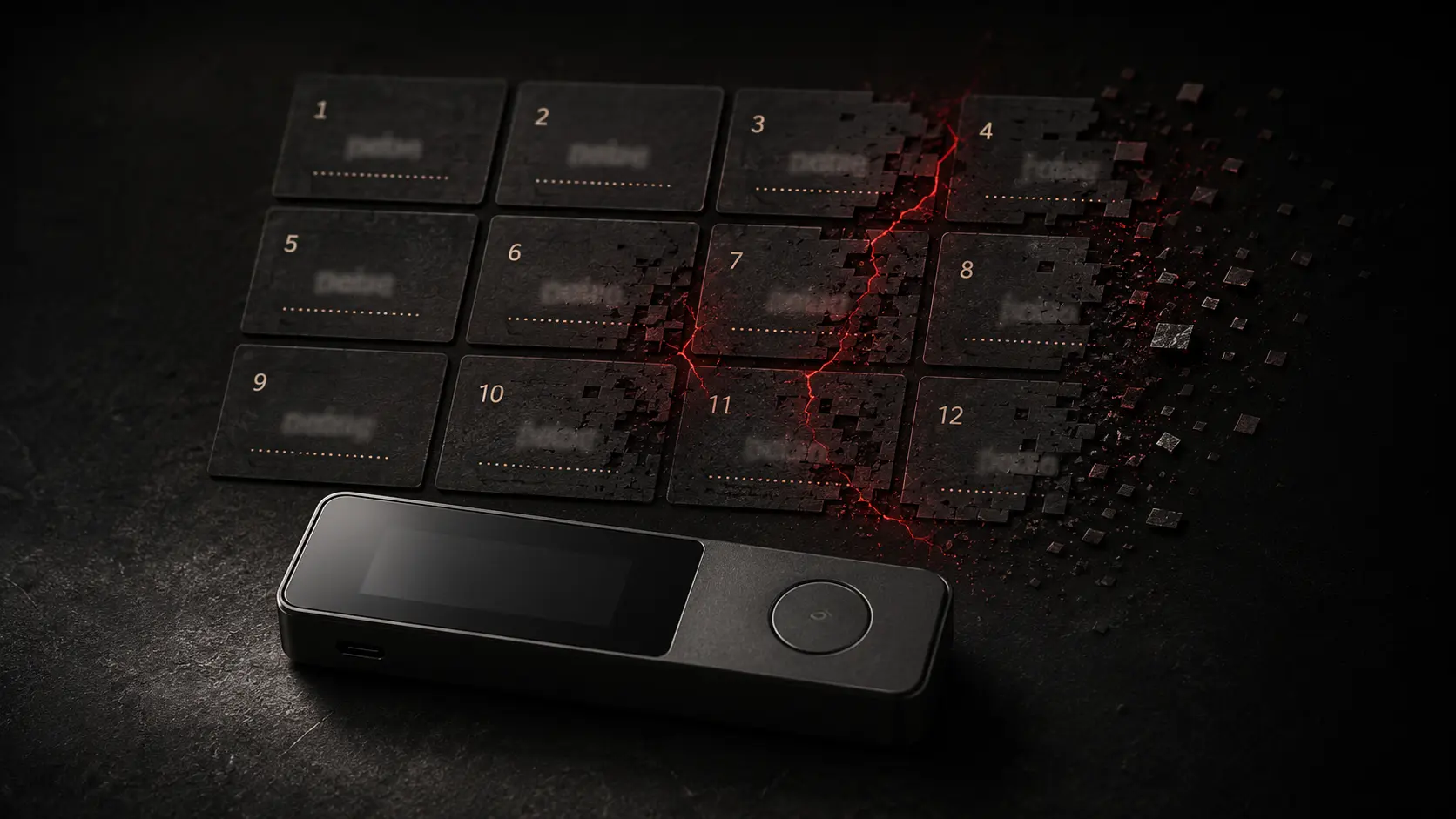
Crucially, installing new firmware does not repair a recovery phrase that has already been generated. The weakness belongs to the seed itself, not merely to the device’s current software.
Was the vulnerability responsible for the reported $38 million theft?
At approximately the same time, blockchain observers identified a coordinated series of transactions in which around 594.5 BTC—worth approximately $38 million at the time—was swept from about 500 single-signature Bitcoin addresses.
The transactions occurred across four consecutive Bitcoin blocks and many of the affected coins had reportedly remained dormant for years.
The timing has naturally led to speculation that the sweep was connected to the Coldcard seed-generation issue. However, that connection should not yet be treated as conclusively established.
Coinkite has confirmed a serious vulnerability and instructed affected users to migrate. The coordinated Bitcoin transfers have also been observed on-chain. But a complete forensic explanation showing that the Coldcard flaw caused every one of those transfers has not yet been released.
The responsible conclusion is therefore:
There is a confirmed Coldcard seed-generation problem and a confirmed large-scale Bitcoin sweep, but the exact relationship between them is still under investigation.
How can a recovery phrase be weak?
A crypto wallet is ultimately controlled by private keys. Most modern wallets derive those keys from a recovery phrase, commonly consisting of 12 or 24 words.
Those words must be selected using sufficiently unpredictable randomness, also known as entropy. With properly generated entropy, guessing the correct recovery phrase should be computationally unrealistic.
But when the generation process uses insufficient randomness, the number of possible recovery phrases becomes dramatically smaller. An attacker who understands the weakness may be able to search that reduced space and reconstruct affected private keys.
This creates a particularly dangerous type of vulnerability because a weak seed remains weak permanently.
Updating the wallet does not strengthen it. Importing the same phrase into a different device does not strengthen it. Storing it more securely does not strengthen it. The only reliable solution is to generate an entirely new recovery phrase using a secure process and move the funds to addresses controlled by that new phrase.
Does this mean hardware wallets are unsafe?
No. Hardware wallets remain one of the strongest available security measures for people holding substantial amounts of cryptocurrency.
They can significantly reduce exposure to:
- Malware running on a computer or phone
- Theft caused by an exchange failure or account takeover
- Accidental disclosure of private keys during normal transaction signing
- Some forms of phishing and remote compromise
However, hardware wallets cannot eliminate every risk. They may still be affected by:
- Firmware or hardware vulnerabilities
- Weak recovery-phrase generation
- Compromised or incorrectly stored backups
- Counterfeit or tampered devices
- Social-engineering attacks
- Users approving the wrong address or transaction
- Loss of the recovery phrase or passphrase
- Physical theft or coercion
The Coldcard incident does not prove that hardware wallets are pointless. It demonstrates that they are one component of a broader security process.
What should affected Coldcard users do?
Users should first determine where and how their recovery phrase was originally generated.
The current device and firmware version are not necessarily what matters. For example, moving a recovery phrase generated by affected firmware onto a newer Coldcard does not resolve the problem. The phrase remains associated with the original generation process.
Coinkite advises affected users to migrate to a completely new seed generated on an unaffected device. Before generating a replacement seed on a newer Coldcard, users should ensure that:
- Mk4 and Mk5 devices are running firmware version 5.6.0 or later
- Coldcard Q devices are running version 1.5.0Q or later
The company recommends recording and verifying the new backup, confirming a receiving address directly on the hardware device and sending a small test transaction before transferring the remaining balance. Users should keep the old backup until the migration has been fully completed and confirmed.
Moving quickly may be necessary, but moving carelessly can create a more immediate risk than the vulnerability itself. Users should follow the official instructions rather than improvising based on social-media posts.
What about a BIP-39 passphrase?
A BIP-39 passphrase creates a separate wallet derived from the recovery phrase plus an additional secret chosen by the user.
Coinkite’s preliminary analysis suggests that a strong, unique BIP-39 passphrase provides an independent barrier against exploitation of an affected seed. But the strength of that protection depends entirely on the passphrase.
A short quotation, familiar phrase, reused password or predictable pattern may be guessable. A Coldcard PIN is not the same thing as a BIP-39 passphrase.
Even users with strong passphrases are being advised to migrate to a newly generated seed. A passphrase may reduce the immediate exposure, but it does not correct the original seed-generation weakness.
Passphrases also create their own operational risk: losing or mistyping one can make the funds inaccessible. They should only be used by people who understand how to back them up and test recovery.
What can other hardware-wallet users learn from the incident?
The broader lesson is not limited to Coldcard.
Keep a record of seed provenance
Users should know which wallet and, where possible, which firmware version generated their recovery phrase. This information becomes critical if a vulnerability is discovered years later.
Do not assume firmware updates fix existing seeds
An update may prevent the creation of additional weak wallets, but it cannot retroactively add randomness to an existing recovery phrase.
Test the complete recovery process
A backup that has never been tested should not automatically be trusted. Users should verify that they can restore the intended wallet and identify its addresses before relying on it for long-term storage.
Treat security advisories seriously
Wallet vulnerabilities may remain undetected for years. Users should monitor official manufacturer channels and verify urgent instructions directly on the company’s website.
Consider multisignature custody for substantial holdings
Multisignature setups require more than one independent key to authorize a transaction. When configured correctly, they can reduce dependence on a single seed, device or manufacturer.
They also introduce additional complexity, so they are not automatically appropriate for every user.
Expect scams during security incidents
Attackers frequently impersonate support teams after a vulnerability becomes public. No legitimate wallet manufacturer needs a user’s recovery phrase to provide assistance.
Recovery words and passphrases should never be entered into a website, sent by email or disclosed to someone claiming to be customer support.
The bottom line
Hardware wallets are not always safe in an absolute sense because no security product can offer an absolute guarantee.
They are better understood as tools that isolate private keys and reduce specific categories of risk. Their effectiveness still depends on secure seed generation, trustworthy firmware, careful backups and correct user behaviour.
The Coldcard incident is especially important because it affects the foundation of a wallet: the randomness used to create its recovery phrase. Once that foundation is weakened, replacing the device or updating its firmware is not enough.
For affected users, the correct response is not panic, but prompt and careful migration to a genuinely new seed generated through an unaffected process.
For everyone else, the message is broader: self-custody removes dependence on an exchange, but it does not remove risk. It transfers responsibility for managing that risk to the owner.
This article is for educational purposes only. Coldcard users should consult Coinkite’s current official security advisory before taking action, as the investigation and recommended procedures may be updated.