WTI Oil Volatility: Middle East Conflict Impact
Why the Middle East Conflict Is Driving Oil Prices
Currently, the price of WTI crude oil is in a state of turbulence.
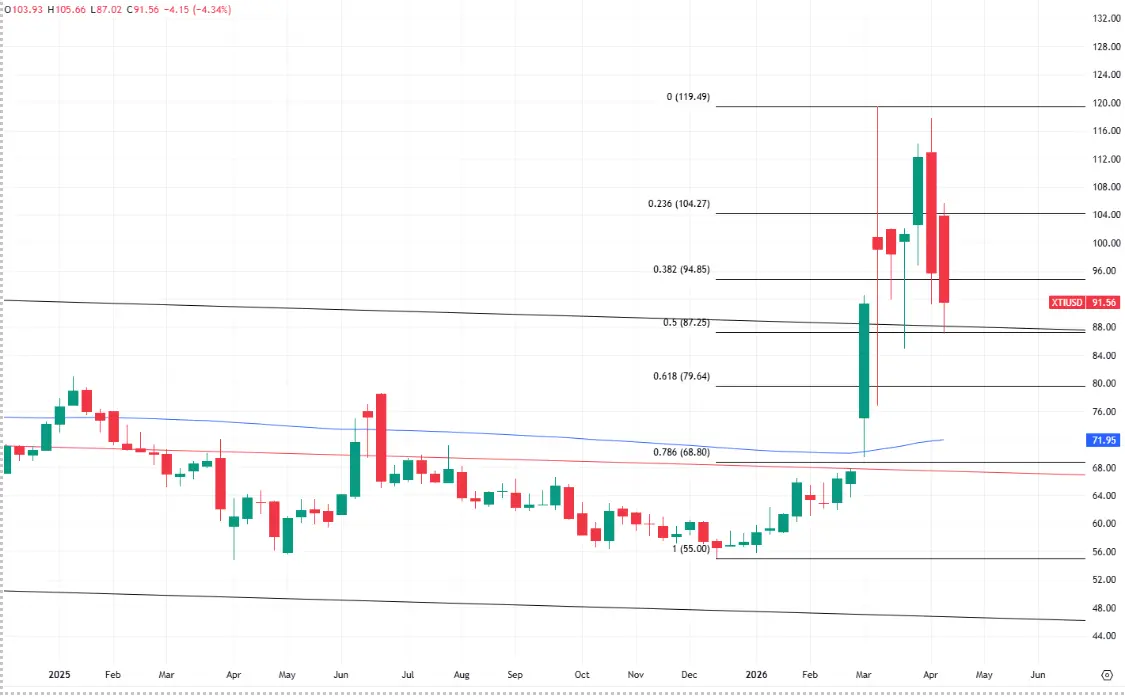
In March, the price of oil rose by more than 50%, reaching $119.5/bbl.
Market volatility has increased significantly due to the outbreak of conflict in the Middle East.
Recall that on February 28, Israel and the United States struck targets in Iran.
The objectives of the operation were: dismantling Iran’s missile and nuclear program, destroying its navy, and regime change.
It is highly likely that the US and Israel were counting on an internal revolution and regime change after eliminating the top leadership of the Islamic Republic, but those plans did not materialize.
Thus, the conflict is becoming increasingly protracted by the day.
Iran’s Production and Its Global Role
Two factors matter for oil prices:
Production within Iran itself. According to the latest OPEC report, the country produces more than 3 million b/d, which is quite significant and accounts for about 3% of global demand for crude oil.
Among OPEC+ countries, Iran ranks 5th in production after Saudi Arabia, Russia, Iraq, and the UAE.
Logistics of oil flows. Due to its geographical position, Iran controls the Strait of Hormuz, a key transport artery for oil.
Approximately 14–15 million b/d of crude oil and another 5–6 million b/d of oil products pass through the strait by sea each day.
The largest volumes come from Saudi Arabia (over 5 million b/d, or about 50% of its total production), Iraq (over 3 million b/d, or more than 70% of its total production), and the UAE (about 2 million b/d).
The primary destination for this oil is Asian countries (especially India and China).
Strait of Hormuz: The Critical Bottleneck
The factor of reduced oil flows through the Strait of Hormuz is key because there is no full-fledged alternative to this artery.
Pipelines built to bypass the strait do not provide the necessary pumping capacity and cannot compensate for the volumes lost from the market due to the closure of the sea route.
The strait is not officially blocked by Iran, but tankers are afraid to move through it due to the risk of attacks.
Consequently, as Lloyd’s List rightly noted, the strait is closed not by Iran but by shipping itself.
The disruption of the strait has already led several Middle Eastern countries to cut production in March by 7 million b/d because their storage facilities are full and oil cannot be transported anywhere.
The result has been a sharp spike in crude prices.
Strategic Reserves vs Structural Supply Risks
To offset the price surge, member countries of the International Energy Agency have agreed to sell oil from their reserves.
A total of about 400 million barrels are to be released. Against this backdrop, oil prices retreated slightly but did not reverse.
The reason is that releasing reserves cannot definitively solve the problem.
Moreover, the used reserves will need to be replenished, which could again lead to higher demand for oil.
Using reserves buys some time to resolve the situation.
In April, Iran and the US managed to reach a ceasefire agreement, which expires on Wednesday, April 22.
Against this backdrop, WTI oil corrected, falling below $100/bbl. If the countries agree to extend the truce, oil prices may fall even further.
However, a ceasefire agreement is only a pause, not an end to the conflict.
As the conflict drags on, it could have serious consequences for the global economy (stagflation and slower global growth).
In due course, we may see global demand for oil decline, and prices will then turn downward.
Key Technical Levels for WTI Crude
Technically, the price of WTI crude oil has fallen to the corrective level of $87.3/bbl, but the bears have not been able to break below it.
If this level is breached, the price could return to the $79.7–80/bbl cluster.